
Training course: Sustainable changes using statistical quality frameworks and standards combined with interaction-based learning.
1. INTRODUCTION
There is a need for informed decisions to handle the current global challenges e.g. decisions on handling the climate change and reaching the 2030 sustainable development goals. Despite this need official statistics is under pressure from several fronts. Walter Radermacher, the former General Director of Eurostat, stresses in the book Official Statistics 4.0 - Verified Facts for People in the 21st Century that the production of statistics must be changed dramatically. He stresses that one cannot simply look at and be excited by the possibilities that the abundance of data offers. When talking about the data revolution, the second revolution, that of the neo-liberal governance, and the third, the populist resistance to expert opinion, should all be mentioned in the same breath.
A recent global survey, conducted by UN, The World Bank and Paris21, Cape Town Global Action Plan Implementation Review, showed that 94% of low and middle-income countries find the coordination in the National Statistical System not satisfactory.
There are many good initiatives that seek to deal with the challenges. However, they are often too detailed and/or difficult to implement in an integrated and compatible way. And often they lack concrete ideas on how to make changes sustainable.
The training in Sustainable Change Using Statistical Quality Frameworks and Standards is an initiative that aims at an integrated view on the production and use of statistics on the one hand and a focus on putting changes into practice in a sustainable way on the other hand.
2. CHALLENGES AND BENEFITS
The table below gives a summary of the challenges and what benefits the training courses will provide.
Challenges
Over-whelming number of challenges
The production of official statistics faces numerous challenges including how to get hold of the new role of data, how to organise ensuring cost efficient use of technology, incl. AI, how to ensure financing, how to handle the missing trust in statistics, etc.
Lack of common terms and understating
Introducing quality framework and standards is used to some degree, but they are often not fully understood and put into the daily work. Each survey follows its own guides and standards, etc.
Competing and incompatible change initiatives
Many initiatives seek to deal with the challenges on separate aspects e.g. statistical literacy, data management, financing, ethics etc. However, they are often very detailed and lack an overall picture, often resulting in sub-optimation and changes pointing in different direction.
Changes are often not sustainable
External contributions often depend on single company solutions and/or on consultants without a proper and sustainable way to proceed with the solution. Furthermore, solution can be too complex, only making sense for some of the involved parties.
Benefits
Integrated perspective on all aspects of the production of statistics
Using statistical quality frameworks provides an integrated perspective, enabling you to understand and get a coherent and comprehensive understanding of all aspects of the production of statistics E.g. in self-assessments.
Statistical quality frameworks and standards provide the needed cognitive capactiy
Sustainable changes using statistical quality frameworks and standards provide the needed cognitive capacity both at the individual and at the organisational level.
Change initiatives must fit into the big picture
Using quality framework and standards together with standards enabling you to put new initiatives into a larger perspective taking the existing situation into account. E.g. introduction of a new cross-cutting solution for dissemination into an organisation using traditional standalone surveys publishing only pdf files can use the statistical process model to ensure the necessary couplings to existing production.
Changes must make sense both individually and in communication in the organisation
Changes using statistical quality frameworks and standards provides a process and learning approach ensuring sense-making in the interaction between the individual and the organisational level.
Section 6 below provides details: : 6.1 me and my specialisation in quality and change 6.2. change model, quality frameworks and standards 6.3 sustainable changes and 6.4 learning approach
3. TO WHOM IS THE COURSE RELEVANT?
In general, the courses are relevant for all organisations in the National Statistical System contributing to Official Statistics, having the National Statistical Organisation as the main player
The course can be tailored, e.g., to Customs Service as data provider focusing on general challenges with additions on how the Customs Service as a data provider can fulfil the needed compliance with the national statistical quality framework.
The course is also relevant for consultant companies and international organisations like UN, WHO, ILO etc, contributing to the statistical development in various countries. The course can be provided as-is, but also as a component integrated into broader projects.
4. THE TRAING COURSE – OBJECTIVES AND CONTENT
Objective of training course:
To introduce quality management frameworks, standards and change models so that participants become familiar with terms and frameworks and know how to implement sustainable changes.
Expected results
After the course the participants will
- understand the context for the work on quality including history of quality, various quality frameworks including quality frameworks used in the statistical community.
- understand and be able to apply the UN National Quality Assurance Framework or similar statistical quality framework in a self-assessment.
- understand and be able to apply a simple change model in three main areas using quality frameworks and standards:
- understand complexity on handling user needs and products and be able to apply a user-producer communication model, methods on describing product quality, etc. and prepare changes options for subsequent prioritisation and decision.
- understand various models and standards used for describing processes and how to apply methods for measuring process quality and prepare change options for subsequent prioritisation and decision.
- understand various aspects of and models used in strategic management, including the content and processes for preparing and implementing strategies taking various contexts into account, including staff and various external contexts.
The training will last for 8 days. It will comprise of the following five modules.
- Introduction to sustainable change using quality frameworks and standards.
- Foundation: basic terminology, quality frameworks and self-assessment
- Statical products and users including a communication model.
- Statistical processes: from planning to production and evaluation
- Activity model for statistical organisations, process management and IT aspects
The training course can have a maximum attendance of 16 persons. Preferable a combination of staff from management, IT and subject matter domains, but also staff from organisations providing data e.g. the central bank.
5. THE NEXT STEP – FREE ONLINE CONSULTATION
Send an email or call me and book a free online consultation. Contact. I will go through the content using between 30 and 90 minutes depending on your preference. You will learn about various aspects related to quality and changes provided in the course. This consultation can be with a larger group of executives.
Subsequently I can have detailed discussion with a smaller group about the possible future help, including the possibility of buying the training course as-is or in a customised version.
6. DETAILS
6.1 DETAILS ABOUT ME AND MY SPECIALISATION IN QUALITY AND CHANGE PROCESSES
I am an independent consultant with 30+ years experience working at Statistics Denmark and as a consultant for statistical organisations in Europe, Asia, Middle East, Latin America and Africa. I have theoretical and practical expertise in change processes and in the production of official statistics fulfilling user needs using various statistical quality frameworks and statistical standards: the Generic Statistical Business Process Model (GSBPM), and other models and standards: GAMSO, BPM, GSIM, DDI, SDMX etc. See resume at LinkedIn
In the last 15 years I have specialized in change processes, quality and metadata. I took part in developing the standards GSBPM, GAMSO and quality reporting standards used in Europe.
From 2012 to 2017 I headed the work on preparing and implementing the Strategy on Quality and Metadata for Statistics Denmark. The work was framed by the European Statistics Code of Practice (CoP) and Quality Assurance Framework (QAF). It included managing changes in all parts of a complex project on the implementation of an integrated and standardised quality and metadata-framework covering infrastructure, data, applications and processes. One of the results is standard based quality reports for 300 surveys. LINK
Recently I conducted two large 10 days training courses in quality management in official statistics in Bangladesh. The list of participants included persons from the Central Bank, the ministry of finance and other external organisations in Bangladesh. The training courses used partly the ideas offered in Sustainable changes using quality frameworks and standards.
The participants are now familiar with, and can use:
- a communication model involving users and producers of statistics ensuring understanding of and improved trust in statistics.
- UN Fundamental Principles of Official Statistics.
- UN National Quality Assurance Framework (UN-NQAF).
- Quality reporting using the SDMX standard.
- the Generic Statistical Business Process Model (GSBPM).
- the Generic Activity Model for Statistical Organisations (GAMSO)
In addition, Business Process Management (BPM) and Enterprise Architecture were introduced.
6.2 DETAILS ABOUT THE CHANGE MODEL, QUALITY FRAMEWORKS AND STANDARDS
Changes vary from small continuous improvement of day-to-day production at survey level to larger cross-cutting projects, including organisational changes. The persons involved vary, but the following model is a common for all changes.
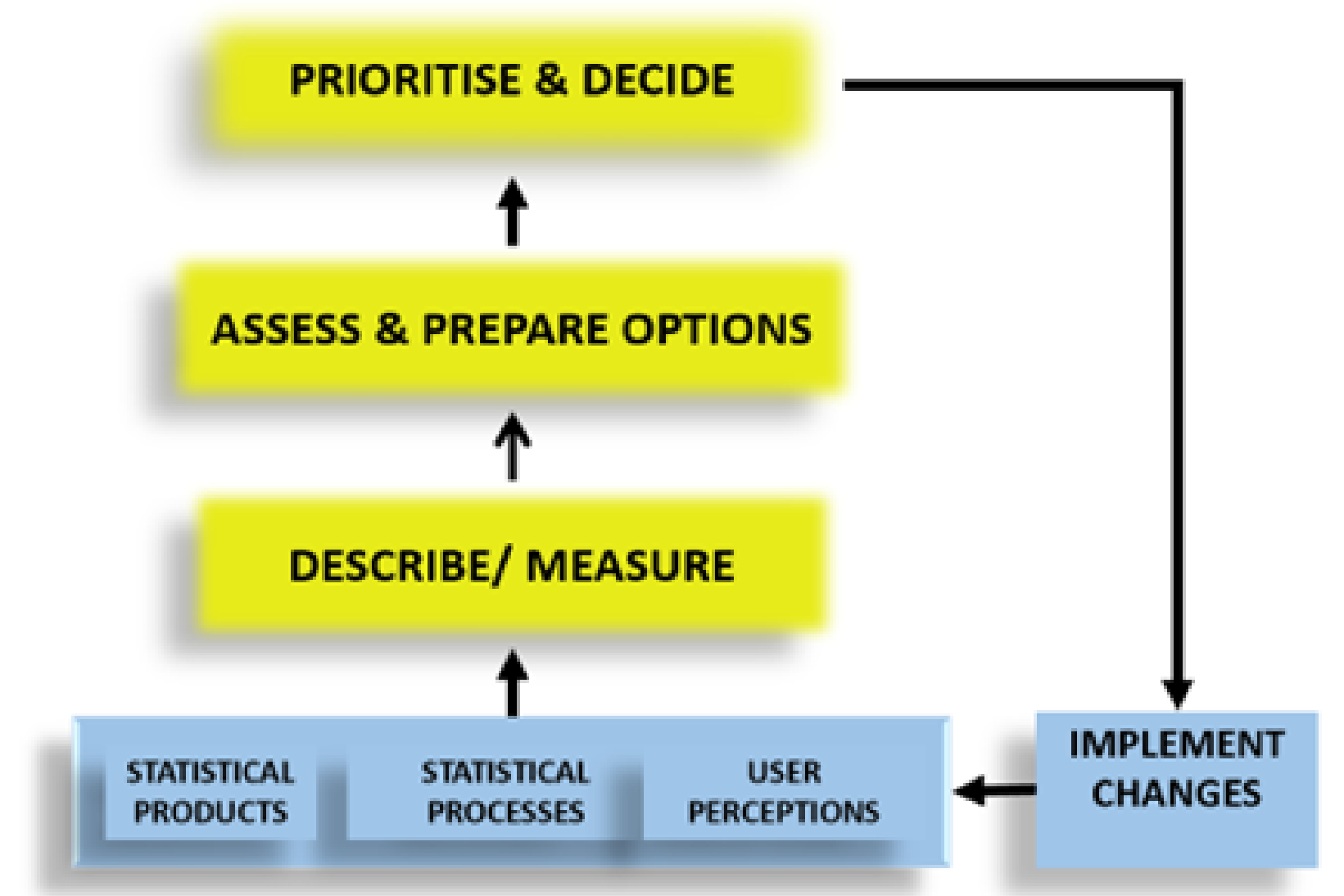
Figur 1. Change model.
The model seems simple, but the crucial two main ingredients in sustainable changes using quality frameworks are the following: A) An integrated perspective the production of statitics and B) An aim for common understanding and sense-making. The integrated perspective is provided by the quality framework and standards. The common understanding and sense-making is provided by a sense-making model and the interaction-based learning approach.
Figure 2 below depicts the four main elements in the training course.
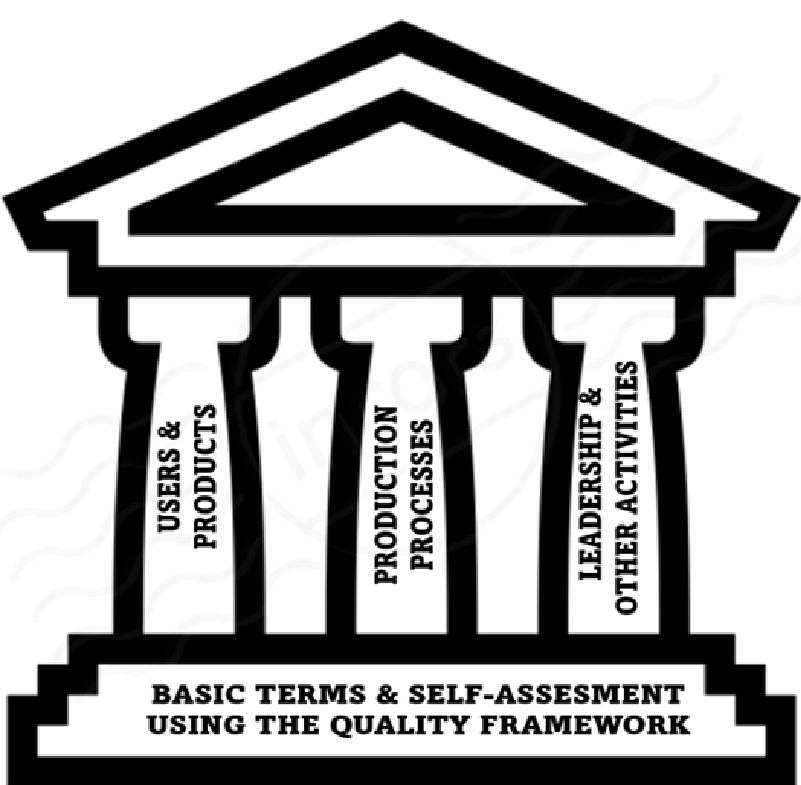
Figure 2. Four main elements in the training course.
The foundation is provided by basic terms e.g. Official Statistics , Quality, National Statistical System and the overall self-assessment. It uses the quality framework to find out about compliance levels.
Figure 3 below presents details about the UN-National Quality Assurance Framework. There are 87 requirements. They are divided into 19 principles and 4 levels: managing the statistical system, managing the institutional environment, managing statistical processes, managing statistical outputs.
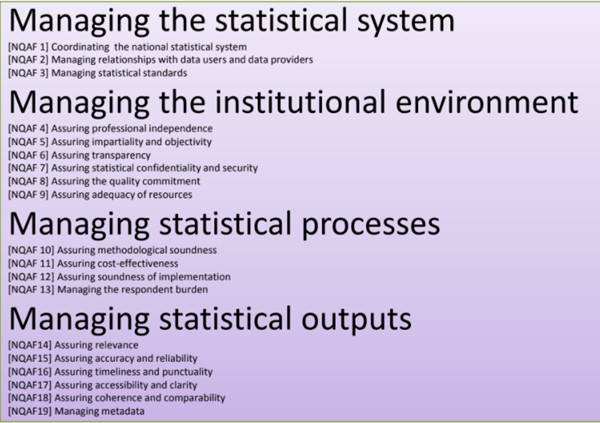
Figure 3. UN-National Quality Assurance Framework: . Four levels, 19 principles and 87 requirements.
Self-assessment is conducted by going through the requirements and accessing compliance levels for each requirement. The three pillars on top of the basic terms and self-assessment focuses on
- Statistical products and users
- The processes in the day-to-day production.
- Strategy, leadership, support and capability development
Each pillar focuses on specific aspects related to the production of statistics using relevant standards. Figure 4 below shows some of the selected standards.
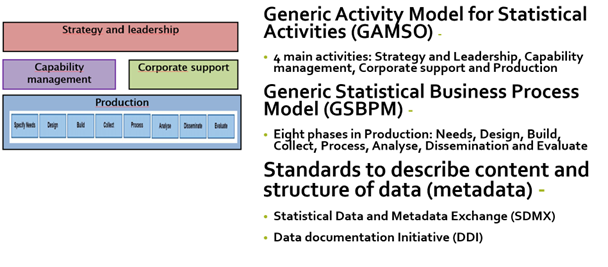
Figure 4. Selected standards.
6.3 DETAILS ABOUT SUSTAINABLE CHANGES
Sustainable changes require that terminology, frameworks and standards are being used actively in the the day-to-day work. Thus, an important idea in the training course is the dual functions of quality frameworks and standards. They generate descriptions and measurements e.g., compliance levels, to be used in quality assessment and improvements, but they do also shape communication and provide the organisation with cognitive capacity. The terminology must be understood and make sense in the organisation. In other words: the measurements of quality are not just simple one-to-one descriptions of reality but are also elements in building individual cognitive capacity and especially in building organisational cognitive capacity as they become part of the communication and understanding in an organisation.
But how to make sure that individual cognition as thoughts and feeling are turned into common organisational cognition in communication among individuals?
The answer is, that sustainable changes requires resonans in the interaction between individuals in the communications as depicted in figure 6 below:
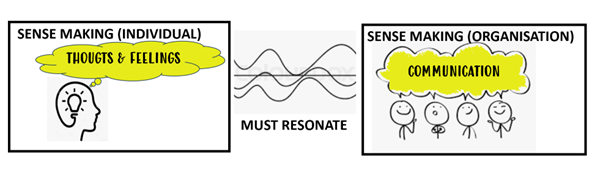
Figure 6. Sustainable changes though sense making and resonans.
This is what the interaction-based learning approach seeks to provide. There can be disagreements on changes between subject matter staff and IT staff or between managers and subordinates. The aim of the training is create resonans and thereby ensuring the optimal solutions via the discussions of possible disagreements followed by preparing changes options.
The much debatet use of AI exemplifies that a possible use of AI can make sense for some individuals, but the needed resonans must be established in the communication and decisions in the organisation.
I have successfully used this thinking when my wife and have disgreements. The only way forward is to express thougts and feelings in our sense-making communication aiming for comprises and resonans respecting that we can think and feel in different ways. We can even have different belief systems and we might even put a white lie into the communication. Thoughts and feelings might be changed in our discussions or by our seeing and listening to frinds, movies, reading articles etc, but I can only judge by my wifes actions and her expressions of thougths and feelings. The relationsship can ultimately be ended without communicatoin and resonans, but so far the communication and resonans has been succesfully been going on and been improving during the last 15 years.
Figure 7 below combines the change model in figure 1 with the sense-making model in figure 6. It emphasises sense-making both in the production of statistics and in the processes presented in the change model from figure 1.
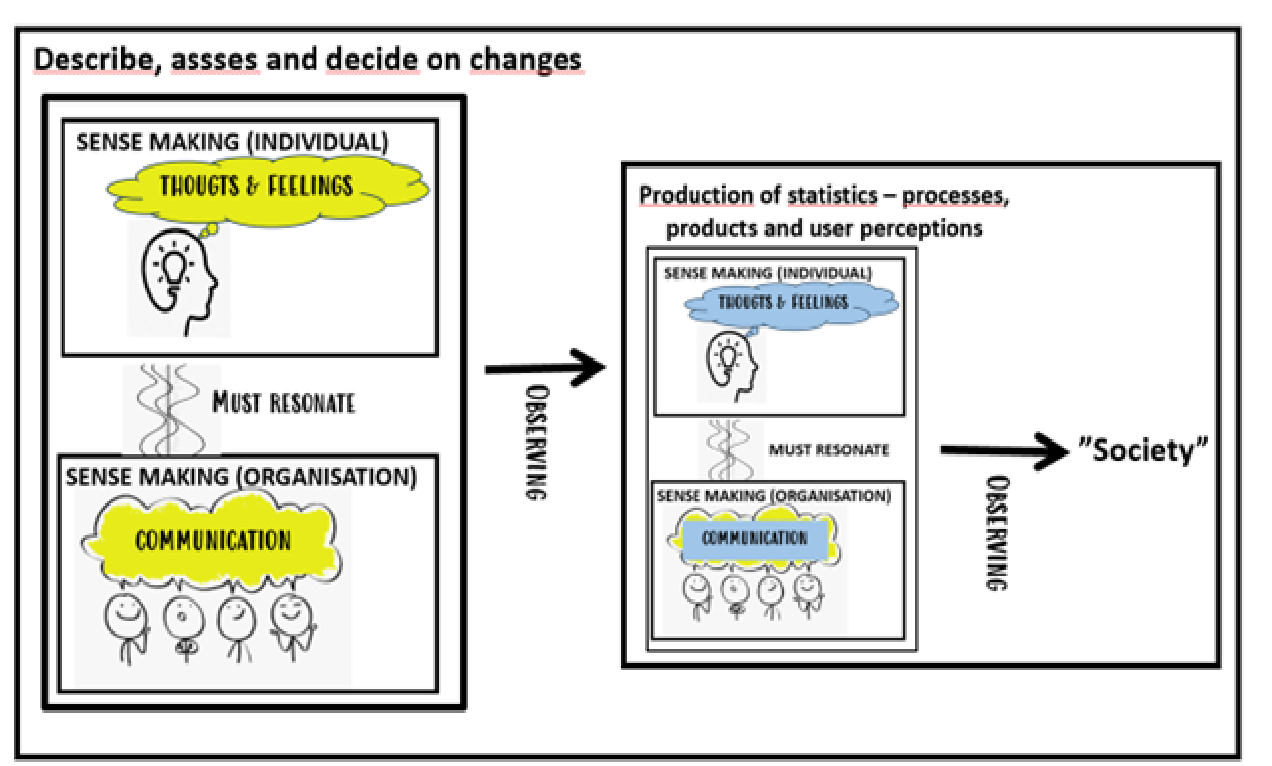
Figure 7. Sustainable changes via sense-making at two levels.
This thinking is implemented throughout the training course.
6.4 DETAILS ABOUT THE INTERACTION-BASED LEARNING APPROACH
The interactive-based learning approach must make sense and ensure the formation of cognitive capacity as described above.
This is in general ensured by a balanced combination of Listening, Speaking, Reading and Writing (like learning a new language). In addition the exercises are carefully designed to ensure sense-making and the building of local cognitive capacity at the individual and the organisational level. Therefore all exercises are related to practical aspect and challenges faced by participants in their daily work. E.g. how to implement changes on improving fulfillment of user needs.
The training has the following four parts being included in each topic.
- Presentation of topic and exercise by the trainer. The aim is to initiate cognition at the individual level via simultaneous listening to the trainer and reading the slides (listening and reading).
- Exercise part a: Individual preparation. The aim is to consolidate cognition at the individual level and relate this to solving the problem in the exercise by combining new information with existing individual cognition (reading)
- Exercise part b: Group work. The aim is to build organisational cognitive capacity by combining the individual cognitions via interaction among participants (listening, speaking, reading, writing).
- Exercise part c: Each group presents results followed by discussion. The aim is to improve and consolidate the organisational cognitive capacity via continued and extended interaction among participants (listening, speaking, reading).